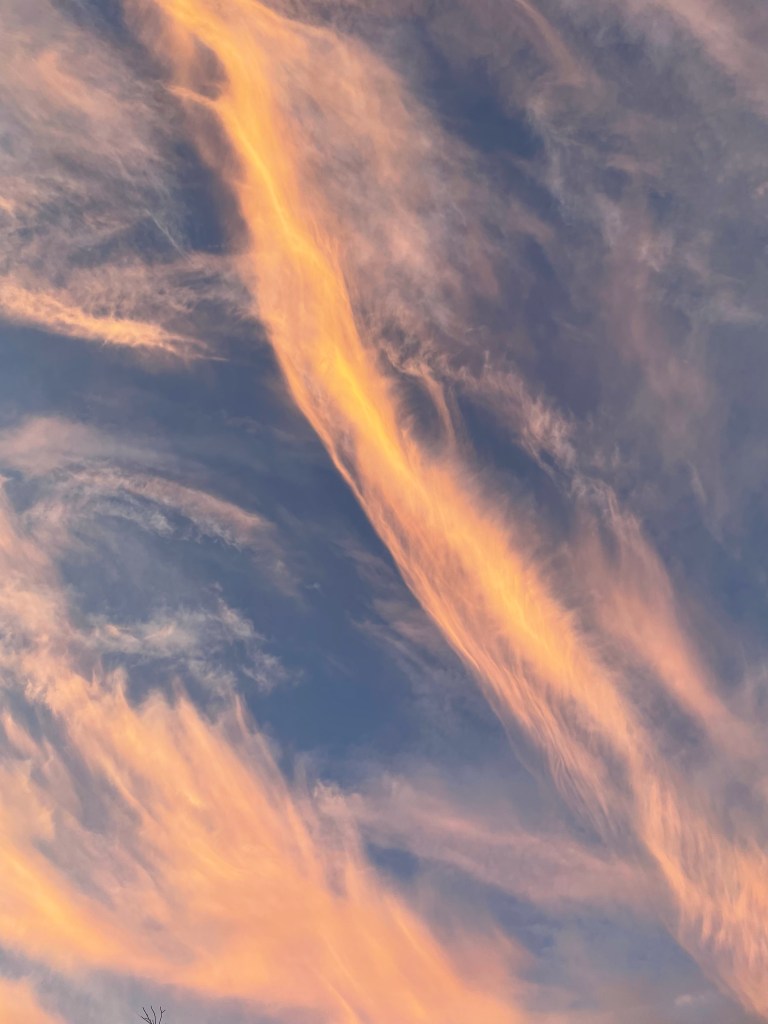
For much of my life, a sign has been posted near the offramp of 66 onto Virginia 123 claiming Tysons as “America’s next great city!” Virginia 123 is also known as Dolley Madison Boulevard, which I’d always heard was to commemorate her brave flight from the burning White House in 1814 with the presidential paintings in tow. (Although as I actually just learned in a quick Wikipedia dive, it was in fact Paul Jennings, Dolley’s “personal slave”, who took the famous painting of George Washington down and prepared it to be sent to New York. And Dolley’s flight was slightly less harried than I’d always imagined it; she spent the first night in Georgetown before crossing the river. On the whole, not exactly the gutsy girl-power story it was always made out to be!) Nowadays it’s the main road connecting the CIA, downtown McLean, and Tysons.
Which brings me back to that sign, which in middle school struck me and my friends as a terrific joke. Every part of it felt bewildering. “Great”? “City”? To us, Tysons was where the mall was. More specifically, it was where every possible iteration of mall was: mega, strip, and upscale. There was the regular mall (Tysons Corner), the fancier mall (Tysons Galleria), the movie theater, the Silver Diner, the Borders, the TJ Maxx, the T-Mobile store, and the bagel place, to name a few. It was a place of pure commerce and bored suburban teenage drama. I spent many an afternoon circling what was then the newly built and thus very exciting part of the mall after watching my best friend try on tube tops that my own breasts could never hope to fill at the Wet Seal. Such, such were the joys.
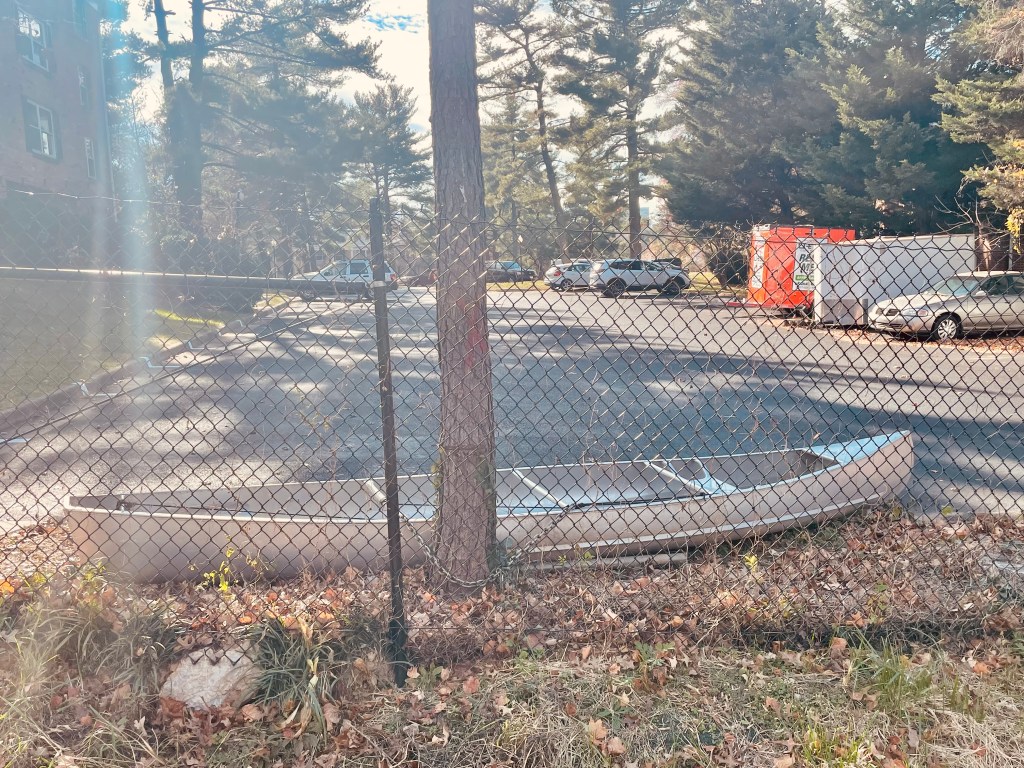
But it never occurred to me that people might actually live there, or want to move there. Even then the area was sliced through with highways. It seemed to offer none of the aspirational comforts of the suburbs – no lawns, no schools, no big houses – while also promising none of the perks of urban life, given that it was mostly unwalkable and lacking community.
Now, I find myself back in this area, staying with my father and his wife while I get a job and figure out where I want to live next. He moved back because he was continuing to work out of Washington and, I think, had a fond association or at least a familiarity with McLean from the time we spent here as a family. He lives on the edge of McLean, so close to Tysons that, among closest friends and with nothing to prove, you might even say he lives in America’s next great city.
This part of Northern Virginia is a strange place, my friends. It is a place with a gated community called “The Colonies”, without a whisper of irony or historical embarrassment. It is a land of basements, and basement culture. Up until middle school, I’d mostly lived between deserts. When we moved to McLean in between diplomatic postings, I had my first brush with everything a basement could be. Basements in NoVA were carpeted “dens”, with pool tables and leather sofas and DDR mats. They were places to watch movies and listen to band rehearsals and feel around for the sweaty hand of your crush in the dark. My first kiss was in a Virginia basement, and it was about as specific and memorable as its beige surroundings.
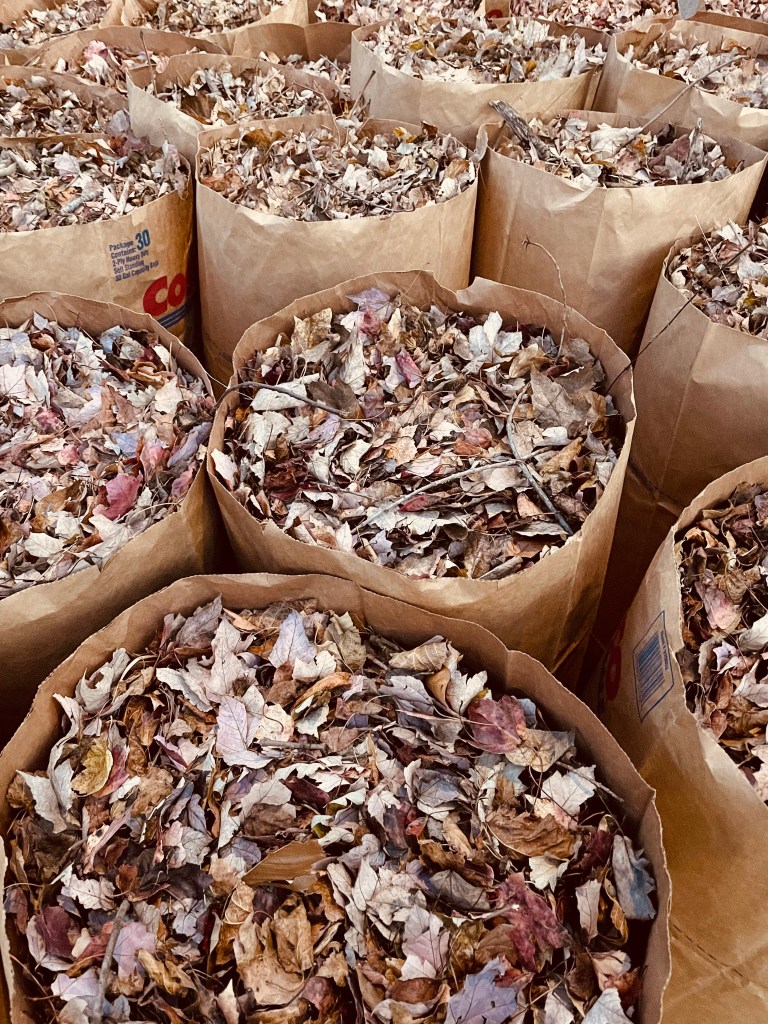
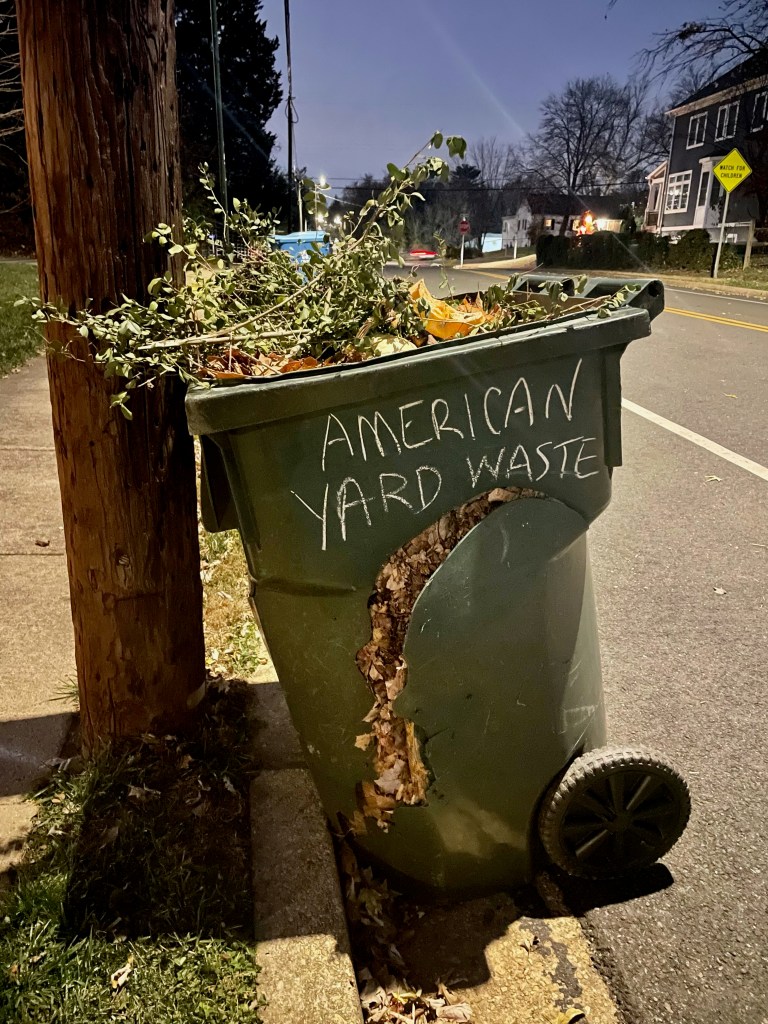
This is a place of regular, compulsive, near-fanatical leaf collection. Sacks upon sacks of leaves in brown paper bags waiting for pick up on every street, in bags from Costco and Lowes and Home Depot, some of them with cheeky phrases like: “I’m stuffed!” It is a place where not picking up one’s leaves is instantly noticeable, and the forgotten leaves drift in crunchy hillocks and carpet the yards of the more conscientious.
It’s a place of juxtapositions and jarring disconnects. Pimmit Hills, a neighborhood here, is full of the houses of an older Virginia, small pre-fabs and craft houses placed on large plots of land with enormous trees. But the neighborhood hums with constant construction as old houses are torn down and replaced with mini-mansions, all rendered in identical aluminum siding and bursting at the edges of their allotments. In Tysons, it’s technically possible to walk from one building to the next, but to do so is functionally to island hop from one corporate campus to another. Each cluster is designed to be self contained, a glassy apartment complex set on top of a Whole Foods or a Wegmans with a few restaurants and a modern-sounding name, like The Boro. Capital One owns much of the area near the metro station and has brought a new music hall. All of this is a complete transformation from my time as a young adult. The hope I suppose is that young people and young families might move to Tysons anticipating they’ll be close to DC, but then discover they have everything they need right there.
But this is also a place of unnerving and unpredictable borders. Black Lives Matter signs living next door to Parents for Youngkin. At least one confederate flag, not too long ago. Christmas displays and nativity scenes so extensive, so over the top, they seem to be daring for comment. It’s worth noting that Northern Virginia is a diverse place, one many different immigrant communities call home. It’s full of people who currently work or used to work in Government and International Development. People who live here or are from here tend to add the Northern for a reason – it’s not quite Virginia. And yet, it is. The mood in some neighborhoods can be one of suspicion. Even without fences, the properties can feel like small islands unto themselves.
What makes a city? And what makes it great? Coming here after Paris, I felt disturbed. There, as with many great cities, I’d step outside and see immediate signs of life. A walk was richly textured: there were people eating, chatting, and buying groceries. You could look in through the store windows and catch glimpses of other lives. There were parks and libraries but more meaningfully there were neighborhoods, ones you had to walk through to get anywhere. In a city, getting somewhere can still be a means of encounter.
And what makes a suburb? I’ve noticed that people who come to the Southwestern United States tend to either love or despise the vastness. For some, it’s profoundly lonely, being able to see so much and feel how small you are on the face of it. But looking out from my window here at the street leading up to Corporate Ridge, a place that glowed orange even at 4 in the morning on the night of the lunar eclipse not too long ago, I feel I would give anything for the honest vastness of the desert. Here, everything is close, and yet one is so often alone. The surburbs promise space at the expense of proximity to other people. They say, you can have a place of your own. A thousand lawns and a long road to anywhere else.
I don’t mean to be so harsh. I tried one evening here to put aside my cynicism and imagine the place with fondness. I could picture the feeling of coming home to my place, a place where I could stand outside and see everything of mine at once. I imagined coming home from work to a place that was decidedly not work, and looking into the kitchen from the driveway. I see the families out biking and see the lawn decorations and know this is home for somebody. For many. And it will only continue to change. Still, will it one day be a city? And will that city be great?
1338 words and I have got to call it quits, these are just killing me! Day 6/10 and yes I skipped yesterday.
Also if you want to read more about the Tysons project, there’s this article from 2011. There’s lots of stuff now too but I like to see the vision of it from an earlier time.
 Ana Olson